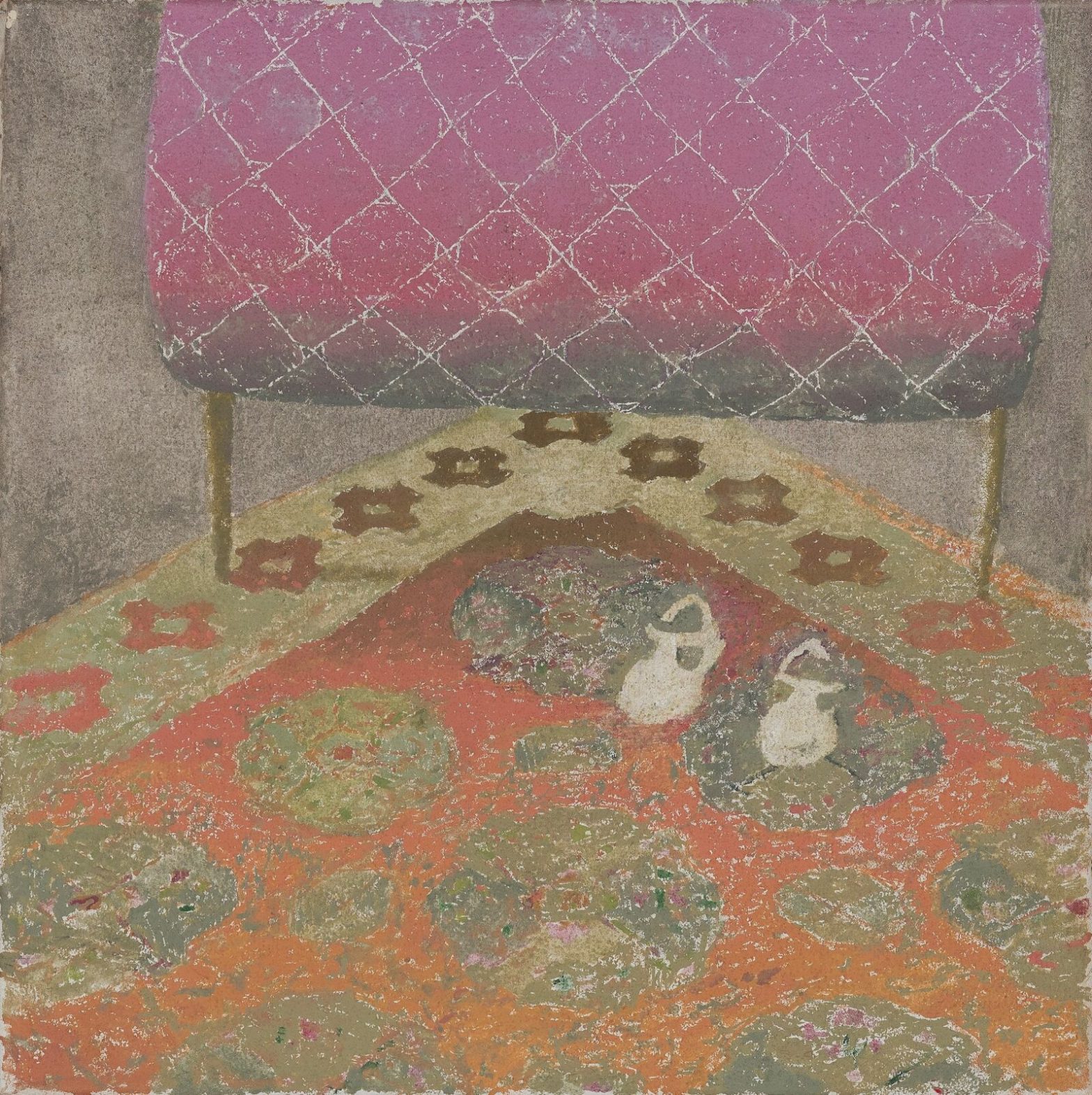
EXHIBITION: DIANA CEPLEANU. SOLO EXHIBITION
OPENING: Friday, 5 June, 18.00 – 21.00
Galeria Plan B is pleased to present Diana Cepleanu’s first solo exhibition with the gallery, featuring paintings and drawings from the 1990s to the present. Accompanying the exhibition, the following excerpt from a conversation with Daria Ghiu offers a glimpse into the artist’s reflections on painting, perception, and the persistent return of the image.
We are in your studio. Have you changed many studios over time?
I built my working territory where I am. Where I am, there is the studio. After university, I
immediately married my colleague Pepine and gave birth to five children. And during this time I worked in the house.
To have this encounter with the canvas every day, was that always important?
I would set up my workspace anywhere, sometimes under the table, sometimes on the doorstep. And I started doing portraits of my children.
How has what interests you in painting changed over time?
I never thought about the subject. In fact, at the Art University in Bucharest, the subject was more of a pretext, the Romanian school was marked by modernism, the importance was always given to plastic means. Subjects, to begin with, were not important to me and little by little I began to see that you can find something to paint in anything. At first I was looking for exceptional things, that is, things that I saw in a landscape, in an object, some objects that were in the house and the light fell in a certain way and the frame was cut in a certain way. But then I started the other way around, to look at everything and in everything to look for that thing that had formed. I don’t know what it was. It’s a kind of relationship between things. And so the subject didn’t really matter. But of course there is always a tension, because even though you are in love with color, shapes, with the abstract side, there always comes the figuration that charms and charms others especially. You can’t give up figuration. And you find yourself in this terrible tension. After painting a lot of portraits, I was very dissatisfied. And then I tried to somehow destroy the portrait, to corrode it. And I think I’m managing to do away with it now. But it still comes back on one side.
It’s fascinating. Even though you’ve fought it, it comes back and you have to find techniques to destroy it.
I destroy any figuration that wants to impose itself on me. The objects want something from me, I don’t know what they want. They, the poor things, will ask me what I wanted from them. I haven’t left them alone.
When does something around you become a painting?
My eyes are so hungry. I sit here, at the window, and look through the spyglass, and I see a tree and I like it. And I immediately say to myself – what a sketch I would make! And suddenly I see a lot of other things: a chimney, another tree, another chimney. And they all start screaming at me: me too! me too! me too. Just like students who want to answer. This is a hunger of the gaze.
Do you work every day in your studio?
I have studios everywhere, at home, at my mother’s house, everywhere there is a nest, where, when I have a few minutes, I can do something.
Do you feel good in the century you were born in?
No, I did not find myself in the century I was born in at all. I went to school where modernism was the lesson. I like the 20th century, but I don’t have much contact with it. I have always looked at ancient art, at Piero della Francesca, at Giotto, at Uccello. Sometimes at Watteau as well. And then I had a great love for Vermeer. I loved Vermeer in college and I looked at him a lot, because it seemed to me that there the abstract is combined with a very pregnant realism.
Have you found your own truth in art or is it a continuous frenzy of searching?
The frenzy remains. It has a name, I call it painting. In painting I always invent and tell myself that ‘this is painting’ and then it turns out that it is not painting. I mean, painting is like that, a kind of Fata Morgana. I don’t know what it is and I realize that it probably isn’t. We all do this. We seek to say what it is, to feel what it is. Practice is the only thing that interests me. The final object is always an oddity. Once I finish a work, it’s dead. It’s going to live out its afterlife. It goes into the realm of meanings. I don’t work there, I only work somewhere below, in an atmosphere, and then it goes out into the stratosphere.
Diana Cepleanu, born in 1957 in Bucharest, Romania, lives and works in Bucharest, studied at the Academy of Fine Arts in Bucharest. Selected exhibitions include: Salon, Lismore Castle Arts, Lismore (2026); IT’S NO CRIME TO TICKLE TIME. 20 Years of Plan B, Galeria Plan B, Berlin (2025); Madeleine Moments, Union Pacific, London, (2025); Now, kaufmann repetto, New York (2025); Denonce-Moi, dependance, Brussels (2025); There were times I wanted to change the world, Paltim, Timisoara (2025); Reunion, AYE Project Space, Hong Kong (2025); Last Night I Dreamt of Manderley, curated by Daniel Malarkey, Alison Jacques, London (2025); snow falls over car hoods over david’s valley, Lutnita, Chisinau (2024); The Humming of colors, Art Chosun Space, Seoul (2024); autoportret, Plan B, Berlin (2023); Lutnita, Chisinau (2023); Voyage dans la couleur (Journey in Color), Vila Magdalena, Nice (2020); Galeria Anticariat Curtea Veche, Bucharest (solo exhibitions, 2019 and 2014); Predelut 4 – Arcus Cultural Center, Sf. Gheorghe (2019); Pentimento – 5th International Biennial of The Art of Miniature, Ruse (2015); Pictori olteni de ieri şi de azi, Muzeul de Artă, Târgu Jiu (2010); Volare (Fly), Desenzano del Garda (2010); EMOZIONI TRA CIELO E MARE (Emotions between sky and sea), Il Gazebo di Gaeta (2010); Iritrattisti (The Portraitists), Il Borgo Gallery, Milan (2009); Pictori peisagisti în grădina Palatului Cotroceni, Galeria Muzeului National Cotroceni, Bucharest (2007); Pictura ca murmur, Galeria Anticariat Curtea Veche, Bucharest (2007); Chipuri de pictori, Galeriile Artexpo, Bucharest (1996).