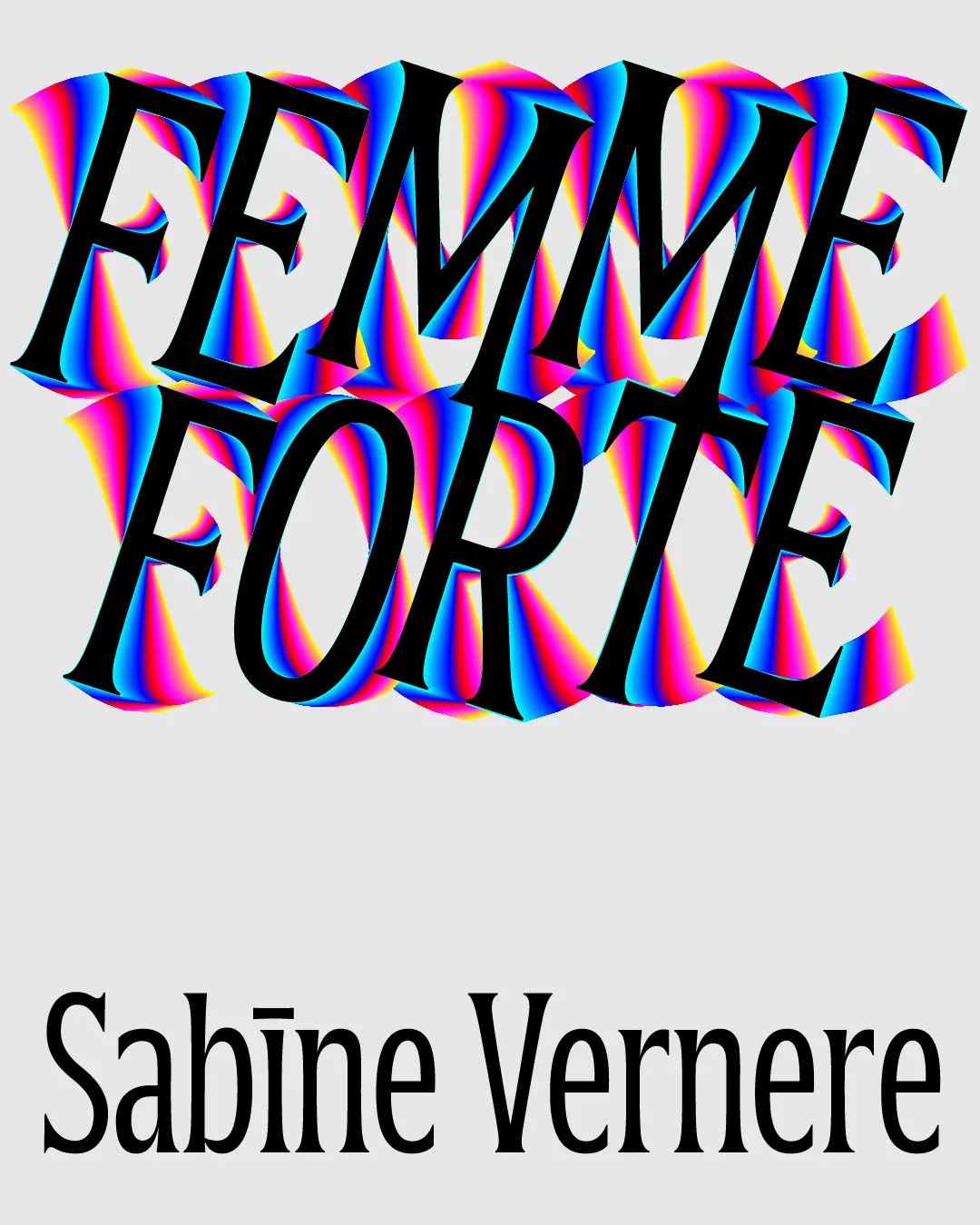
EXHIBITION: FEMME FATALE. SABĪNE VERNERE
OPENING: 12/02/2026, 18.00
Curated by Maria Helen Känd
In her upcoming solo exhibition, Femme Forte, the artist Sabīne Vernere – previously known for working primarily with black pigments – turns toward vivid colour, taking inspiration from the sun itself.
The colours of sunrise and sunset emerge from the interaction between short and long light waves and the Earth’s atmosphere. In Vernere’s new works, this optical phenomenon becomes a metaphor for women’s voices and histories. When the sun sinks below the horizon in the evening, its light enters the atmosphere at a more acute angle and, so, must travel a longer distance to reach the Earth’s surface. As a result, blue light scatters and disappears, while the red light remains. In Femme Forte, a light blue tone marks the more delicate forms of the feminine as the saturated colours of twilight symbolise voices growing stronger through resistance.
A similar analogy of revelation is offered by the aurora borealis, in which invisible solar winds meet the atmosphere to create intense colours. Layered greens, pinks and purples evoke the way individual stories converge into a shared spectrum. Forming at the threshold between cosmos and air, the aurora mirrors Vernere’s spirals that depict a liminal space signalling transition.
Through this luminous palette, Vernere invites us to imagine empowering examples of women’s self-realisation – stories that are scarce in recent Baltic history. There have undoubtedly been women in this region who led successful creative and professional lives despite the obligations and constraints placed upon them. Yet these successes often came at the expense of personal well-being. Many women from the past century ended their lives alone and in poverty or were worn down by political repression or illness. In contrast, the representations of the female in Vernere’s new works are imbued with an energy captured in the braided anatomy of joints and tissues and ready to burst out. Alongside them, enlivened figures are already moving, striving forward and upward. And there are also supple, tender hand- or budlike forms tentatively exploring the surface.
Where did this search for female role models begin? During her doctoral studies, Vernere researched the most famous of femme fatales – the Sirens, Medusa and Pandora. These ancient Greek heroines embodied sexuality and power, only to be met with revenge, punishment and hurt. Vernere’s attention was drawn to the unjust suffering these figures were forced to endure because of their seductiveness. She also became interested in the assigned female guilt that runs through mythological narratives and, in particular, how these foundational texts of European cultural history, written by men, reveal a deep-seated fear of female sexuality. She wanted to understand why it continues to be suppressed and misrepresented, and why victims are still blamed. These archetypal figures became a lens through which to examine how anxieties surrounding female sexuality persist in contemporary post-Soviet Eastern European society.
Alongside her academic research, these ideas simultaneously took shape within Vernere’s artistic practice. In her early ink and egg tempera paintings, she freed the female body from its constraints, allowing sensuality and strength to emerge through abstraction. These works deconstructed and transformed parts of the female body. Although presented in dramatic black pigment on white paper, the bodily form itself remains fluid, playful and gentle – through these depictions, Vernere brought forth the curiosity and vitality inherent in women. Hopeful visions, found in both Vernere’s earlier and new works, shape our understanding of free women. We witness figures who move forward with purpose to carve out lives of creativity and beauty.
Vernere paints these vivid images with seriousness and quiet conviction. She embraces classical techniques and materials – egg tempera, ink, bronze, oil paint, marble and oak – yet also transforms them, uncovering new forms of expression through her contemporary, female perspective. Figurative, colour-rich painting, long pushed to the margins of the art world, is once again finding its place alongside other contemporary artistic forms. Unafraid of being dismissed as illustrative or naïve, Vernere’s Femme Forte intervenes not only in the commentary on social processes but also in the internal dynamics of the art world itself. As the elements and scenography of the gallery space suggest, the exhibition is capable of shifting multiple perspectives at once, in a single, decisive gesture.
Text by Maria Helen Känd