EXHIBITION: IRMINA RUSICKA, KASPER LECNIM | NOT ONLY FLOWERS WILL GROW
OPENING: 21/03/2026, 18:00–21:00
Curator: Katarzyna Krysiak
Cooperation: Zuzanna Mielczarek
The starting point for the exhibition by Irmina Rusicka and Kasper Lecnim at Foksal Gallery is the spiral neon form from the façade of the former Central Department Store (CDT, today Smyk) in Warsaw. Designed and manufactured in the German Democratic Republic in the 1950s and imported to Poland as part of cooperation between socialist countries within the Council for Mutual Economic Assistance, the neon sign functioned as a symbol of modernisation – a visual promise of growth and progress. The abstract, dynamic spiral ending in an arrow had no identifiable author; it operated as a systemic sign, emanating energy and faith in the future. Today, it can be read as a remnant of an unfulfilled utopia – a fragment of a visual language that has lost its agency yet continues to exert an impact.
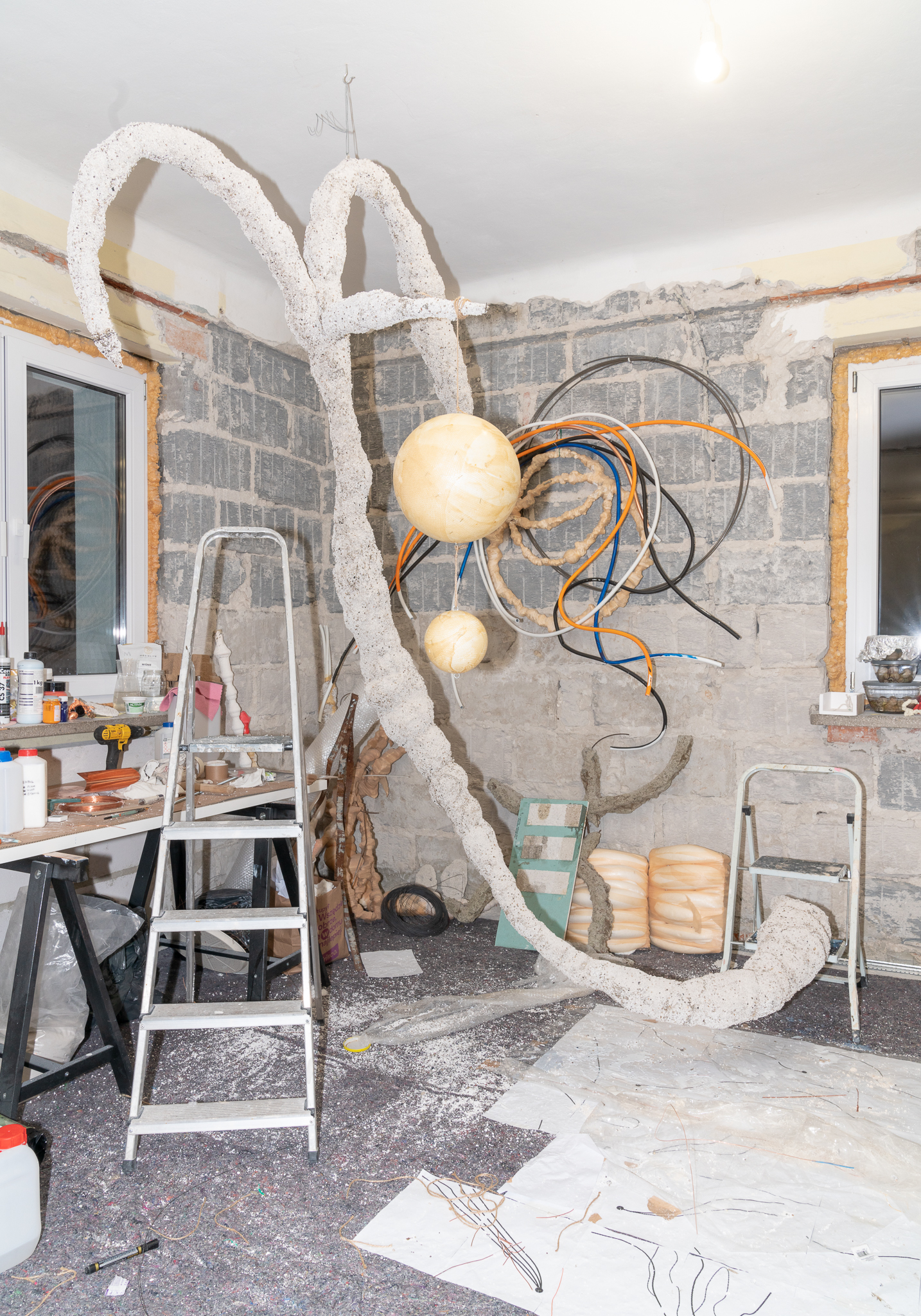
The form of the neon sign recalls Edward Krasiński’s spatial installations presented at Foksal Gallery in 1966. Already iconic in Polish art history and known from Eustachy Kossakowski’s photographs, the linear, flexible structures running through the gallery interior – stretched, suspended, bending in accordance with the rhythm of walls and passages – resembled a stream of matter or light in constant motion. Krasiński’s works did not exhaust themselves as autonomous objects. Instead, they constructed situations in which form existed only in relation to place, scale, and the viewer’s trajectory. What emerged was a process: a tension between the energy of gesture and the resistance of architecture. Rusicka and Lecnim’s project operates in a similar register, treating space not as a background but as an active field of action.
The objects presented in the exhibition are made of industrial and recycled materials – pipes, wires, rubble, and plastics. They resemble archaeological artefacts: forms extracted from the ground, fragments of past structures that have lost their original function. It is a matter of dilapidated buildings and settlements, dust and debris in which processes of decay and transformation are recorded. From these remnants, Rusicka and Lecnim construct new arrangements: temporary structures balancing between movement and stillness.
The exhibition develops the metaphor of growth, understood not as linear progress but as a cycle of emergence and decline. The recurring motif of a leaf carried by the wind seems to echo Walter Benjamin’s interpretation of Paul Klee’s Angelus Novus – the angel of history propelled forward by the storm of progress while ruins accumulate at his feet. The wind of history brings no consolation; it is a force that compels movement even when everything material is falling apart. In this sense, Rusicka and Lecnim’s objects can be read as forms suspended between hope and the awareness of loss – attempts to build from what remains.
The project also enters into dialogue with the tradition of spatial art developed at Foksal Gallery since the 1960s. The installation is arranged so as to respond physically to the interior of the gallery – its proportions and structural tensions. The scale of the objects constantly negotiates with the possibilities of the space, creating a situation in which form, place, and time intertwine into a single, fragile composition, poised between the memory of modernist promises and the material reality of their collapse.
_____
Irmina Rusicka – visual artist working with sculpture, photography, and installation. She graduated in psychology and art history (MISH, University of Wrocław, 2014) and media art at the Academy of Fine Arts in Wrocław (2017). In 2016–2017 she studied at the Academy of Fine Arts in Warsaw in the studios of Krzysztof Wodiczko and Prof. Grzegorz Kowalski. Her artistic practice has involved actions such as crashing cars, repairing a motorbike, performing a cartwheel in the Mausoleum of Soviet Soldiers, and raising funds to drill a hole in the wall of an art institution. She is a recipient of the International Visegrad Fund scholarship and the Grotowski Scholarship. She received the Trójka Talent Award (2018) and the WARTO Award (2019), and was a finalist for the Grey House Foundation Award (2018). Her work has been presented at Zachęta – National Gallery of Art, the Museum of Modern Art in Warsaw, and BWA Wrocław, among others. She works individually and in collaboration with Kasper Lecnim. A member of OFSW, she lives in Warsaw.
Kasper Lecnim – visual artist, graduate of the Eugeniusz Geppert Academy of Fine Arts in Wrocław. His practice spans multiple media. He has produced scarves, organised house removals, cleared snow, crashed cars, and challenged directors of cultural institutions to duels, among other activities. He works individually and in collaboration with Irmina Rusicka. His work has been presented in solo and group exhibitions at institutions including Zachęta – National Gallery of Art, the Museum of Modern Art in Warsaw, Gdańsk City Gallery, Wrocław Contemporary Museum, Trafostacja Sztuki in Szczecin, and the Centre of Polish Sculpture in Orońsko. He lives in Warsaw.
Free entry.