EXHIBITION: THE PRESENT AS FOUND
OPENING: 02/10/2026, 20.00
Curator: Dajana Bilbija
The divergent creative practices of this year’s Zvono Award finalists – Ljiljana Arsić, Isidora Branković, Mustafa Mlinarević, and Emina Veladžić – have shaped a media-heterogeneous, methodologically diverse, and conceptually multilayered exhibition. Although it is not possible to unify their works under the same thematic or formal framework, when placed within a shared exhibition context, they reveal a certain closeness in the position that the artists occupy in the contemporary social moment. The title of the exhibition, The Present as Found, stems from the generational position of the finalists and the socio-political horizon within which they were formed. Their growing up took place within a reality they did not choose, but whose social structures, value patterns, contradictions, and unresolved issues they inherited as the framework of their own experience. Therefore, the title of the exhibition does not attempt to bring these distinct artistic practices under a single interpretive framework, but rather names the position from which the artists reflect on the present in which they have found themselves.
The winner of this year’s Zvono Award, Emina Veladžić, in her artistic practice re-examines the relationship of the individual to the institutional and technological systems that mediate their experience. How do the systems within which we live produce versions of reality that subsequently acquire institutional authority? This question is opened in her work Incubation, originating from the personal experience of the artist, in which an official police report about a harassment case becomes part of the artwork. Through an administrative procedure, the experience of harassment was reduced to the statement that an unidentified man “addressed the complainant by her name.” The authority of the official document enables this produced version of the event to remain its official record, despite the difference between the administrative log and the live experience of the person it concerns. At the same time, the title of the work establishes both a literal and metaphorical meaning of the concept of “incubation” as a process of creating controlled conditions in which, in the words of the artist, a “formalized untruth” contained in the document is incubated. Placed inside a metal drawer heated to a constant temperature, the document becomes the center of a system whose heat turns the reading of the document into an immediate physical experience that physically engages the viewer and produces discomfort as an integral part of the encounter with the work.
The question of the relationship between the individual and broader social circumstances continues in the artistic practice of Isidora Branković, who examines the ways in which political, social, and economic factors participate in forming personal and collective identity. In the video work Kiss me softly, the artist starts from the process of preparing and sending stray dogs from Bosnia and Herzegovina for adoption to Germany, using the fable format as an artistic procedure to raise questions about migration, belonging, and the idealization of a foreign system. The absurd claim that Bosnia and Herzegovina borders Germany points to a symbolic closeness between the two countries, established through decades of migration and the image of Germany as a “promised land.” The process of neutering, as one of the conditions for departure, acquires in such a context a metaphorical meaning of adapting to the demands of a new system, raising the question of the price an individual accepts in pursuit of different life circumstances. The author’s text accompanying the video work also gives this perspective a generational dimension through the sentence, “If only my grandfather had gone to Germany,” with which the artist connects the imagined possibility of a different present to the decisions of previous generations and the circumstances that an individual finds as their own starting point in life.
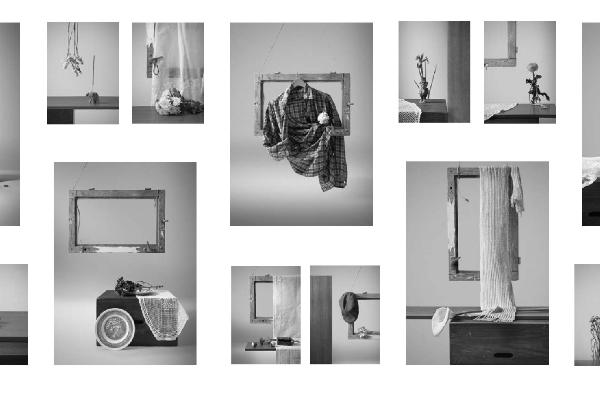
With the work of Mustafa Mlinarević, the exhibition’s perspective shifts from broader social issues toward a more intimate space of personal heritage, within which the artist views artifacts of the past as active factors in shaping memory and the present. The work Objects of Meaning combines a series of photographs of staged scenes and an installation in the form of a window frame, exploring how inherited objects become carriers and mediators of memory. The objects in the photographs belonged to deceased people from the artist’s immediate surroundings and function as material traces that maintain and evoke their memory. Extracted from their original context and placed into imaginary settings that evoke a recognizable atmosphere of a family home, the objects lose part of their biographical specificity and become open to the projections of other people’s memories. By inviting the viewer to recognize elements of their own home within the presented settings and recall the memory of loved ones who once filled it, Mlinarević translates an individual experience of loss into a broader, potentially shared experience.
Ljiljana Arsić positions herself in a similar space of personal narratives, approaching the past from the perspective of a generation that learns about it through the traces of those who experienced it directly. The inherited past becomes the starting point of an intergenerational dialogue through which the artist, in her video work Dialogue, brings into relation her mother’s experience of wartime Foča and her own experience of growing up after the war in the same city. The sentence, “We listened to some stories about a time that we didn’t see,” which the artist speaks in the narrative part of the video work, defines the position of a generation that did not directly experience the wartime past, but grew up in a post-war reality shaped by its consequences. The dialogue between mother and daughter does not equate their experiences, but rather opens up the possibility of a different relationship toward the inherited past, so that the present found, although shaped by it, does not remain entirely determined by it.
By bringing together different artistic practices within a shared exhibition context, the exhibition The Present as Found indicates that the reality we find cannot be viewed separately from the processes, structures, and legacies that preceded it and continue to act within it. At the same time, the works of the four finalists show that what is found is not necessarily unchangeable, but that the present remains a space toward which it is possible to establish one’s own relationship and participate in its further shaping.