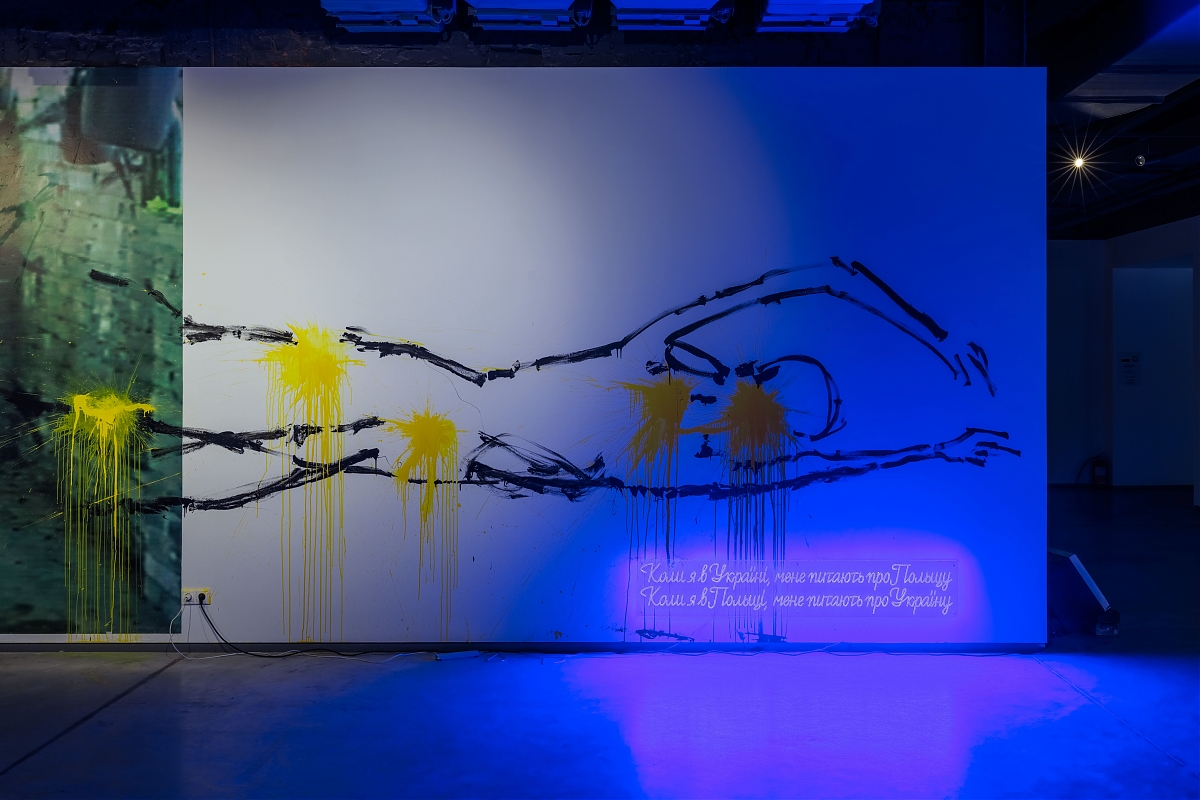
When I Am in Ukraine, Everyone Asks Me About Poland. When I Am in Poland, Everyone Asks Me About Ukraine
When I am in Ukraine, everyone asks me about Poland. When I am in Poland, everyone asks me about Ukraine is a multilayered solo exhibition by Polish artist and curator Waldemar Tatarczuk, offering Ukrainian audiences an in-depth look at his multifaceted creative identity.
The exhibition marks Tatarczuk’s return to his personal artistic practice after many years of directing Galeria Labirynt in Lublin, a city that is 100 km from the Polish-Ukrainian border, where he focused on fostering the work of others. This experience deeply influenced his artistic language, shaping the key features of his practice: political awareness, attention to others, collaboration, and coexistence. A work which opens the exhibition — Moving Towards East — literally embodies both the political and artistic movement of the artist toward closeness with Ukrainian art, its support, and his continued presence within this cultural space.
The project unfolds in two parts. The first comprises works created in collaboration with Ukrainian artists and long-term friends and colleagues who accepted Tatarczuk’s invitation to engage in joint artistic dialogue. This section echoes the spirit of Galeria Labirynt, which under his leadership became an experimental institution with a distinctly anti-institutional ethos. During times of political and social turbulence in Poland, Labirynt remained active and responsive by following artistic rather than bureaucratic logic. The gallery also played a crucial role in supporting Ukrainian artists and fostering Polish–Ukrainian artistic exchange from the very beginning of Tatarczuk’s tenure.
The second part of the exhibition turns inward, presenting the artist’s individual works and performance documentation. This intimate and reflective space reveals a personal dimension that has long remained in the background of his collective efforts. While Dnipro audiences may already be familiar with Tatarczuk’s curatorial activities, this archival section highlights him as a key performance artist who, since the late 1980s, has consistently explored the intersection of the corporeal and the political, moving toward empathy, solidarity, and coexistence.