DISCUSSION WORKSHOP: CONTEMPORARY ARCHIVAL PRACTICES
On 23 April at 18:00, the Latvian Centre for Contemporary Art (LCCA) will host a discussion workshop titled “Contemporary Archival Practices” at its archive and library at 13 Alberta Street, Riga. The workshop will explore the role of formal and informal archives in shaping cultural memory and artistic narratives in the Baltics and Eastern Europe — a region marked by colonial legacies, geopolitical instability and ongoing change.
The event continues the interdisciplinary series “Safety Zones and Shifting Timelines,” which explores the fragile relationships between the archives and collections of art institutions, collective memory, and the shifting political landscape in the Baltic region. Project curator – Andra Silapētere.
The series is structured around three discussion workshops with participants from the Baltic states, the Czech Republic, and Poland, complemented by interventions in the LCCA archive and library by artists Luīze Rukšāne, Rūdolfs Štamers and Sabīne Šnē. Each subsequent artist’s intervention builds upon the previous one and the body of work will be on view until 30 September, 2026. The exhibition is open Wednesday through Friday, 12:00 –18:00. Admission is free.
The discussion, “Contemporary Archival Practices”, will explore how archives can challenge inherited power structures and bring decolonial narratives to the fore. It will also consider how their diverse forms can help us to envision the future of the region’s art and culture. The discussion will also explore how archives can be used as tools to encourage critical reflection, preserve memory, and foster new forms of collaboration in uncertain conditions. Finally, the discussion participants will address the challenges and opportunities involved in adapting archives to the contemporary context, including the use of language and the role of digital and physical formats.
Participants: Eglė Juocevičiūtė (LT)—art historian, critic, and curator at the Lithuanian National Gallery of Art in Vilnius — and the editors-in-chief of the online contemporary art magazine MOST—Ewa Borysiewicz, Vera Zalutskaya, and Katie Zazenski (PL). The discussion will be moderated by LCCA curator Andra Silapētere.
Project context
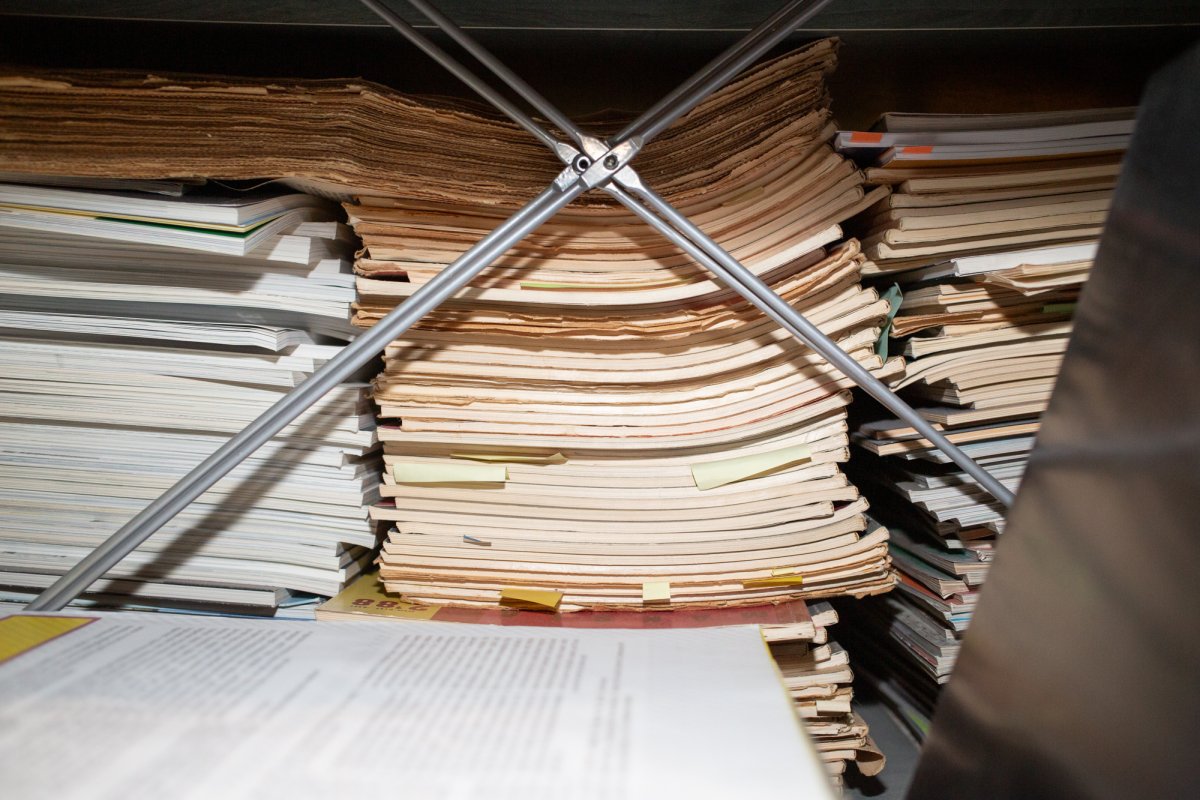
At the heart of the “Safety Zones and Shifting Timelines” series is the archive of the Latvian Centre for Contemporary Art, which has its roots in the Soros Center for Contemporary Art – Riga, established in 1993. One of its core missions was to collect and disseminate information about contemporary art in Latvia. Following the cessation of SCCA-Riga’s operations in 1999, the LCCA took over its functions, significantly supplementing, reviewing and expanding the accumulated information. Today, the LCCA archive is one of the most important resources for documenting contemporary art processes in Latvia dating back to the 1960s.
Over the past decade, the LCCA has concentrated its efforts on contextualising the archive, exploring themes such as gender, minorities, individual and cultural memory, and environmental issues. One approach to examining the past is to involve contemporary artistic strategies and collaborate with researchers and artists from the Baltic region and former socialist bloc countries. However, the question of the possibilities for sustainable and critical analysis remains important in these processes. Therefore, “Safety Zones and Shifting Timelines” will explore how diverse and alternative research, creative, and institutional practices can transform our thinking about knowledge-making in culture and art, and how these processes are actualised.
On participants and presentations
Eglė Juocevičiūtė as a curator at the Information Centre of the National Gallery of Art in Vilnius, the heir to the archive of the Soros Contemporary Art Centre, will discuss it as both a time capsule and a resource for research that takes place today. An important part of this archive is the so-called artist monographs: dossiers comprising overviews of artists’ oeuvre, press clippings, black-and-white photos, color slides, and short accounts of selected artworks.
The dossiers were – and in some cases still are – an invaluable resource for both local and foreign researchers and curators. The earliest ones, compiled between 1993 and 1996, were intended to pay tribute to the artists and artworks that had been marginalized during the Soviet era. The texts produced during this period serve as compelling examples of discursive experimentation amidst a rapidly shifting system of values.
Eglė Juocevičiūtė is an art historian, art critic, and curator at the National Gallery of Art in Vilnius. In her curated exhibitions, she interrogates the visual and conceptual continuities across different art fields within the context of Lithuanian art of the last 100 years. Her academic research focuses on semantic transformations within discourse on visual art.
Ewa Borysiewicz, Vera Zalutskaya, Katie Zazenski
The co-editors-in-chief of MOST magazine will speak about the ethos and practices that define the platform, and will reflect on its role as an informal archive, shaping the narrative of a Central and Eastern Europe region historically defined by imperial influences and currently facing geopolitical and also in many cases, institutional instability.
The panel will explore the editors’ approach to English as a situated and adaptable language, and MOST as a space for highlighting solidarity practices and independent initiatives across the region that are not market-oriented, tracing artistic and critical connections across diverse and uneven contexts.
Their presentation will also explore how conditions of instability and transition can inspire new modes of collaboration and resilience.
Links to related texts:
• Growing a Grassroots Ecosystem: FRINGE Warszawa by Ewa Borysiewicz
• Resisting the Headwind – the OFF Biennale Turns Ten by Teodora Talhos
• Easternfuturism as Temporal Resistance by Rebeka Erdelyi
The series commissioned for “There Is Nothing Solid About Solidarity” (Kyiv Biennial satellite program):
• “Samizdat: The Press Body of the Collective” by Maxim Poleacov
• “‘Eastern Europe’ in Air Quotes” by Petrică Mogoș and Laura Naum
• “DECOLONIAL SOLIDARITY” by Svitlana Matviyenko
MOST Magazine is an online, English language contemporary art journal that focuses on the region known as Central and Eastern Europe. Defining this term broadly, MOST is interested in tracing artistic and cultural practices, mapping local identities, and highlighting both commonalities and diversities.
MOST is a resource for both a regional and international audience and presents art writing, exhibitions, and projects in the visual arts (primarily but not exclusively), with a special focus on regions that face underrepresentation. MOST is oriented towards both emerging and established writers and readers who are interested in broadening their understanding of this region, as well as making the region more accessible to an international audience who might not have the proximity or connection to contextualize such works and subjects.
MOST is an independent initiative, formally established in 2023 by Vera Zalutskaya, Ewa Borysiewicz, and Katie Zazenski, who work non-hierarchically as a co-editor-in-chief team. The goal for MOST is to create a critical cultural platform that is sustainable for its editors, authors, and readers in terms of both professional and affective labor.
Ewa Borysiewicz is an art historian, writer, curator, and researcher based in Warsaw. Her work focuses on theories of consciousness, epistemology, and the history of science, as well as digital art practices, particularly the use of video game aesthetics and mechanics in contemporary art. She is the author of “Kinetic Vertigo”, a study of the political and emancipatory dimensions of camera-less animation through the work of Julian Józef Antonisz. She previously worked at the Adam Mickiewicz Institute (2012–2019) and co-organized the gallery-share initiative “Friend of a Friend” (2018–2022). In 2024, she was awarded a curatorial residency by the Igor Zabel Association in Ljubljana. Her writing has appeared in Flash Art, e-flux Criticism, Camera Austria, SPIKE, Texte zur Kunst, Art Basel Stories, and others. She has curated exhibitions at Zachęta National Gallery in Warsaw, M HKA in Antwerp, and Manggha Museum in Kraków. She is co-founder and co-editor-in-chief of MOST Magazine.
Vera Zalutskaya is contemporary art curator, writer, cultural manager, and editor. Her research focuses on how decolonial and post-socialist thought can map shifting regimes of representation—attending to fluid identities, contested visibility, and the subtle image-operations through which subjectivity, belonging, and agency are produced and negotiated. She is a co-founder of MOST magazine and of the Identity Crisis Network. She serves as President of the GESSEL Foundations for the National Museum in Warsaw and for Zachęta—National Gallery of Art. Since 2014, she has curated exhibitions and projects in Belarus, Belgium, Denmark, Poland, Serbia, Slovenia and Croatia, including at the Museum of Modern Art in Warsaw (MSN), the Museum of Contemporary Art in Zagreb (MSU), Copenhagen Photo Festival, CPH:DOX, and M HKA Antwerp.
Katie Zazenski is an artist, curator, writer, editor and lecturer whose practice is centered around cultural production and community building in independent, artist-led communities. From 2018-2026 she directed the Warsaw-based independent art space Stroboskop. From 2020-2024, Zazenski was a writer and editor for BLOK magazine. In 2022, Zazenski initiated FRINGE Warszawa and currently serves as a co-organizer. In 2024, she co-founded MOST Magazine where she currently serves as co-editor-in-chief. In 2025, she co-founded MUD LAB. Zazenski received her MFA in Sculpture from Cranbrook Academy of Art and is a two-time Fulbright scholar in Poland where she has lived since 2015.
Organized and supported by
“Safety Zones and Shifting Timelines” is organized by the Latvian Centre for Contemporary Art. Project curator: Andra Silapētere.