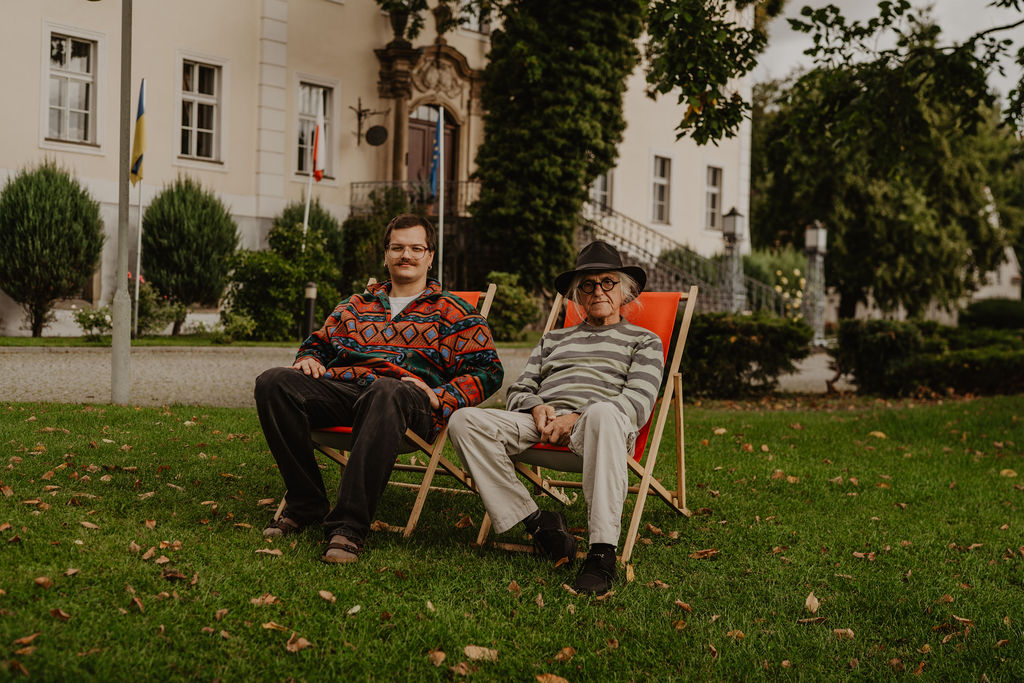
EXHIBITION: AND WHAT DID YOU DO DURING THIS TIME? POST-RESIDENCY EXHIBITION BY ALIAKSANDR DANILKIN AND ADAM RZEPECKI
OPENING: 20/03/2026, 18.00
Curator: Paulina Brelińska-Garsztka
Tour with the artist and curator: 24/03/2026, 18.00
OPENING HOURS DURING THE EVENT:
Wednesday, Friday, Saturday: 14:00 – 18:00
Thursday: 14:00 – 20:00
Each day during 66P Stajnia’s opening hours, one of the project’s co-creators, Aliaksandr Danilkin, Adam Rzepecki, and curator Paulina Brelińska-Garsztka, will be on site to provide visitors with details about the exhibition. FREE ENTRY.
The exhibition presents the results of six weeks of work by two artists whose biographies and artistic languages differ significantly. What they share, however, is a reflection on memory and time as well as their parallel activities during the Konrad and Paweł Jarodzki Artistic Residency in Krzyżowa at the turn of September and October 2025.
Adam Rzepecki reflects on Krzyżowa in the context of overlapping temporalities and the ethical consequences of looking back. His main source of inspiration was an excerpt from a letter written in 1941 by the founder of the so-called Kreisau Circle, Helmuth James von Moltke (1907–1945): What shall I say when I am asked: And what did you do during this time? Transposed to the present, the question loses its character as a historical quotation and directly refers to the processual nature characteristic of artist residencies.
It also offers a critical reflection on the requirement for productivity and the key role of archival research, which prompted the artist to observe the constellation of stars above Krzyżowa in February and October 2025. As a result, he created a painterly interpretation of time in which the present and the past intertwine, achieved by superimposing two astronomical perspectives. During the residency, in line with his latest interests, Rzepecki also created a music notebook that formed the basis for a performance. In consultation with the artist cellist Paulina Owczarek premiered a composition inspired by Ludwig van Beethoven. She used a historic instrument that came into the possession of Esther Braun-Kinnen after the Second World War with the intention that it “serve a worthy cause”. It was later donated to the Foundation, whose goal is to overcome divisions and strengthen European understanding.
Aliaksandr Danilkin brings out another dimension of this Lower Silesian village – for him, Krzyżowa becomes a point of reference in his reflection on resistance and hope. His experience of living under Alexander Lukashenko’s dictatorship means that the history of the Kreisau Circle is interpreted as living proof of the possibility of resistance.
Referring to the Belarusian tradition of malyavanki (painted wall carpets), Danilkin creates painterly compositions in which ornament and historical narrative are combined with personal experience. The objects themselves, drawn from Belarusian folklore, were tangible evidence of material culture, protecting local tradition from oblivion. Motifs of earth, nest, and circle function in this context as signs of fragility, permanence, and the cyclical nature of geopolitical changes.
The painter explored places important from the point of view of Krzyżowa’s history, such as the House on the Hill and the avenue of oak trees leading to the palace complex. He was also inspired by Krzyżowa’srole in Poland’s recent history, particularly the historic gesture made by Prime Minister Tadeusz Mazowiecki (1927–2013) and German Chancellor Helmut Kohl (1930–2017) during the Reconciliation Mass celebrated here on 12 November 1989. This key political act became an important motif in one of the canvases created by Danilkin during his residency.
Like Rzepecki, the artist also drew inspiration from the stories he heard during his walks around Krzyżowa, translating one of them – about the bell cemetery – into visual language.
The projects by Adam Rzepecki and Aliaksandr Danilkin create a dual narrative about Krzyżowa as a place open to future visionary narratives. Both approaches are united by attentive listening to the context of the Lower Silesian residency centre.
———————————————-
Aliaksandr Danilkin was born in 1996 in Homel, Belarus. Between 2012 and 2020, he studied painting at the State College of Fine Arts and the Academy of Fine Arts in Minsk. During his studies, he fought against censorship imposed by the university, and after the 2020 presidential election he actively participated in protests, expressing his opposition to the dictatorship. He was expelled from the university for his activities and forced to flee his homeland. Since then, he has been using art as a form of protest, addressing contemporary political issues through the prism of Belarusian history and culture.
He currently lives and works in Wrocław, where he defended his thesis at the Faculty of Painting of the Academy of Art and Design. He collaborates with the Poznań-based Barak Kultury Foundation, organisingnumerous individual and collective exhibitions.
https://www.instagram.com/aliaksandrdanilkin/
Adam Rzepecki is a performance artist, sculptor, installation artist, photographer, painter, filmmaker and curator. He studied art history at the Jagiellonian University in Kraków.
In 1979, he founded Łódź Kaliska – a group that changed the face of Polish art in the 1980s through its unconventional activities. In the first half of the 1980s, he co-founded Kultura Zrzuty – a nationwide alternative movement of young art that marked a “third way” in the bipolar political and social situation of the time. From 1978 to 1981, he ran the Jaszczurowa Gallery of Photography in Kraków. Since 2022, he has been active in the UNDERGROUND KRAKOWSKI Supergroup, co-founded with Jerzy Kosałka, Zbigniew Libera and Piotr Lutyński. Recently, he has also been composing music and creating sound installations.
Paulina Brelińska-Garsztka is a curator, artist manager and art critic. Member of the research trio ¿Czy badania artystyczne? (together with Zofia Reznik and Zofia Małkowicz) and Proces Współmyśleń(dedicated to the implementation of artistic research in Poland), curator of the OP_YOUNG programme and the Konrad and Paweł Jarodzki Artistic Residency 2025. She is associated with the Wrocław Institute of Culture, where she coordinates residency projects and international activities. For many years, she has been involved in artistic and curatorial research, both theoretically and in practice. In 2018, she organised the research and curatorial exhibition Voyager’s Record, which became the subject of her master’s thesis. In 2020, she co-created the first conference in Poland dedicated to artistic research. She experiments with various formats of cooperation between artists, institutions and magazines, attaching particular importance to international dialogue and the exchange of artistic practices. She has published texts in e-Czas Kultury, Contemporary LYNX, Magazyn SZUM, Didaskalia, NN6T, Artluk and Zeszyty Artystyczne, among others.
The exhibition was created as part of the Konrad and Paweł Jarodzki Artistic Residency 2025 programme.
Organisers: 66P Subjective Cultural Institution; Krzyżowa Foundation for Mutual Understanding in Europe