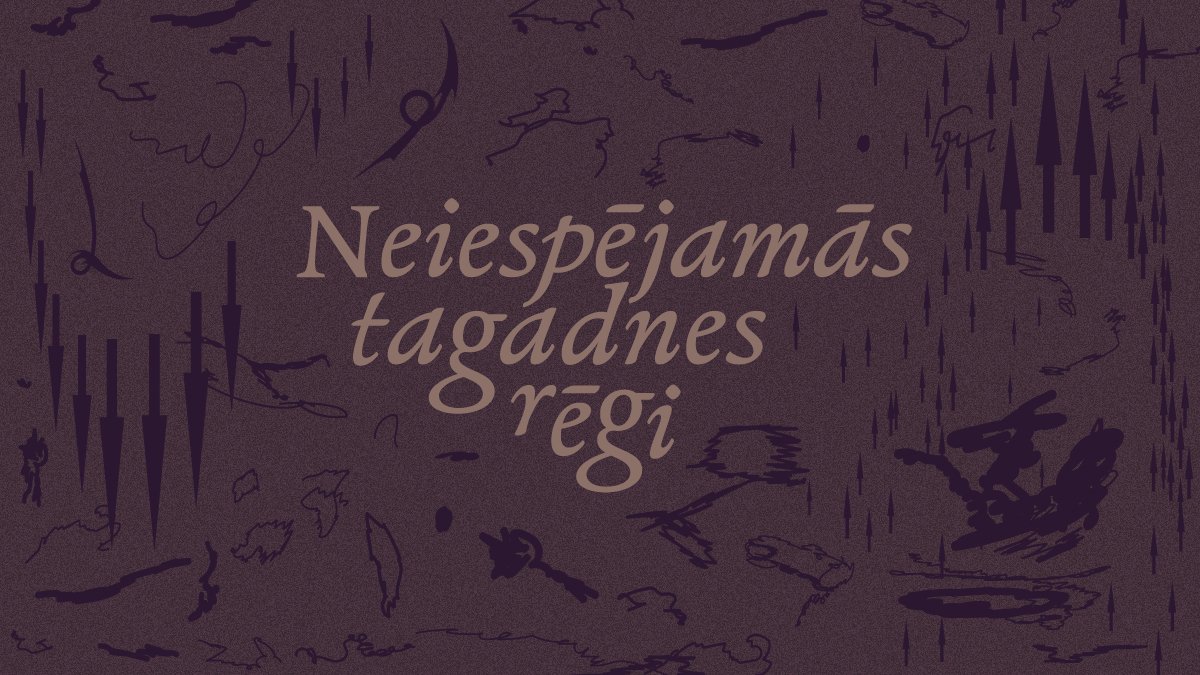
EXHIBITION: GHOSTS OF IMPOSSIBLE PRESENT
From February 20 until April 19, the contemporary art exhibition Ghosts of Impossible Present will be on view at the Pauls Stradiņš Medicine History Museum (MHM), addressing ecologically traumatised environments and their interaction with humans. The exhibition is organised by the Latvian Centre for Contemporary Art (LCCA), in collaboration with MHM, and features the participation of artists from the Baltic states.
“The Baltic region is full of silent witnesses – ghosts resulting from ill-considered industrialisation, extractive economics, and political mistakes, as well as Russia’s full-scale war in Ukraine. The exhibition invites us to listen to these testimonies. The ghosts being mentioned are not just a metaphor,” comments Solvita Krese, the exhibition’s curator and the director of the LCCA.
In 2024, the exhibition Ghosts of Impossible Present was presented at the art space State of Concept Athens, where it was organised by LCCA. Developing its concepts further, this new exhibition in Riga has been created in collaboration with researchers from the Pauls Stradiņš Medicine History Museum and includes items from the museum’s collection. These allow us to explore Soviet-era notions of the body’s interaction with ecologically traumatised environments, as well as the imprints of ideology on thinking about health, nature, and social roles.
In the exhibition, artists from Latvia, Lithuania, and Estonia – Linda Boļšakova, Liene Pavlovska, Līva Dudareva, Eglė Budvytytė, Kristina Õllek and Elo-Reet Järv – offer an associative perspective on the ghosts of our shared ecosystems.
Imprints of the past, which are stored in rocks, fossils, and the urban environment, will be brought to life with the help of movement and sound in works by Linda Boļšakova. A critical rereading of the patriarchal power verticals of the Soviet era will be presented by Liene Pavlovska, with encyclopaedias from that time being used as evidence of ideological constructions. Kristina Õllek, in her works, studies the ecological processes of the Baltic Sea, especially the proliferation of cyanobacteria or blue-green algae, which yearly poses a threat of ecosystem collapse. In Līva Dudareva’s works, rock modules resulting from nuclear tests, and their imprints upon the human body, become frightening reminders of the fragility of peace and the possibility of war. The cast of Eglė Budvytytė’s film embody hybrid forms of life inhabiting post-apocalyptic landscapes. Meanwhile, Elo-Reet Järv sculptures made of skin and fossils – created several decades ago and remarkably innovative for the time – blur the boundaries between stone and animal, and human and cyborg.
Team
Curator: Solvita Krese (LCCA)
Curator for the Pauls Stradiņš Medicine History Museum collection section: Ieva Salna (MHM)
Exhibition architect: Līva Dudareva
Graphic design: Kristiāna Marija Sproģe
Artists:
Latvia – Linda Boļšakova, Līva Dudareva, Liene Pavlovska
Lithuania – Eglė Budvytytė
Estonia – Kristina Õllek, Elo-Reet Järv
Project director: Mārīte Lempa (LCCA)
Further information here.