EXHIBITION: MARIA ANTO | CORAGEOUS SLUGGARD
Curator: Agnieszka Rayzacher
Collaboration: Olga Madler
The exhibition of Maria Anto (1936–2007) at lokal_30 takes place in the year of her 90th birthday. The artist was born in Warsaw in 1936, at a time when international Surrealism was flourishing. Surrealists had a specific attitude towards women – they saw them as muses, objects of passion, femmes enfants, and ephemeral beings, always deeply dependent on men. However, many outstanding women artists were involved in the movement, including Leonora Carrington, Leonor Fini, Remedios Varo, Toyen, Dorothea Tanning, and Lee Miller.
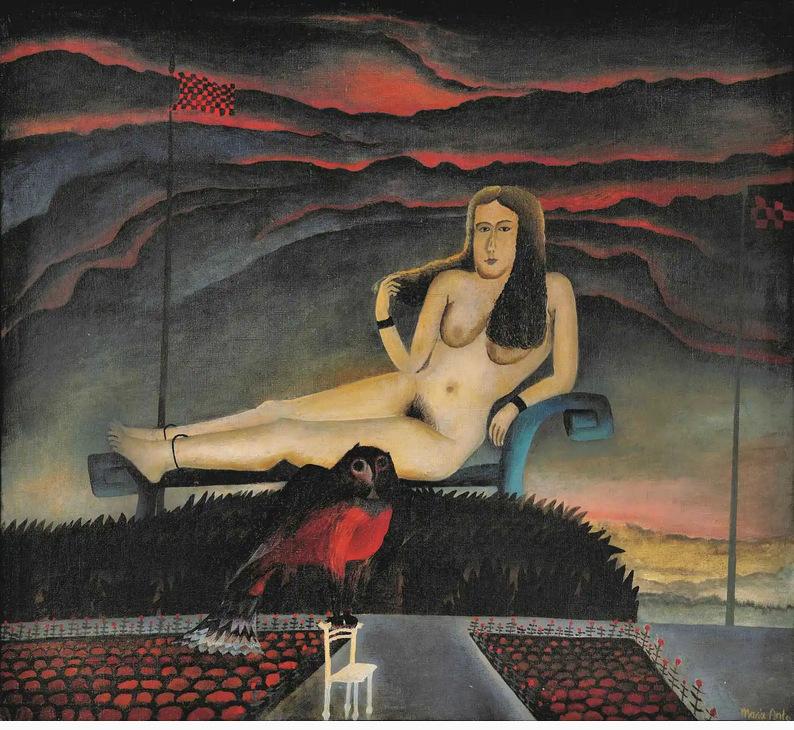
Working in the spirit of Surrealism, Anto had a solo exhibition at Warsaw’s Zachęta Gallery at the age of thirty. It was also then that she created Courageous Sluggard – a full-body self-portrait from a series inspired by dreams, which became a manifesto of freedom and courage for the young artist. It can also be interpreted as a portrait of the community of women artists, referring to the derogatory phrase “courageous and sluggish”, which was often used by male artists.
Courageous Sluggard, Maria Anto’s first solo exhibition at lokal_30, is an attempt to present Anto as a strong individual and an artist who followed her own path while nevertheless remaining connected to her artistic milieu. Her awareness was shaped, on the one hand, by her education at the Academy of Fine Arts in Warsaw and, on the other, by her home environment. Her mother, Nelly Egiersdorff, one of the first women to study at the Faculty of Philosophy at the University of Warsaw, had a particularly strong influence on the young Maria. Anto’s erudition and deep grounding in culture prevented her from working in complete isolation from the major artistic and intellectual currents of her time. This is reflected in her close relationships with figures such as Dino Buzzati, Enrico Baj, Max Ernst, Dorothea Tanning, Erna Rosenstein, Barbara Jonscher, and Karol Tchorek. The potential and talent of the young Maria were recognised by Ryszard Stanisławski, who in 1963 invited her to participate in the 7th São Paulo Biennial, where she presented twelve paintings.
The exhibition focuses on the influence of biography on the development of artistic practice, which, according to Griselda Pollock, constitutes an important context for the study of women’s art. Maria Anto’s work was undoubtedly influenced by her childhood in occupied Warsaw, deaths of her loved ones, and the rescue by partisans of little Marysia and her mother, Nelly, from a train bound for Auschwitz. Making her debut in the early 1960s, the artist achieved success at an early age, both nationally and abroad. At the same time, she was raising four children and combining domestic responsibilities with constant painting and social activity. She was active in Solidarność Artystów (Artists’ Solidarity), and during martial law she opened her studio to the independent art circuit. Anto was a very social person; she made many portraits of her friends and depictions of gatherings, both social and familial. She loved driving and travelled extensively, including for professional reasons, such as her participation in artists’ plein-air sessions – beginning with the Osieki plein-air in 1966 and continuing with annual trips to Białowieża – as well as her collaboration with Milan’s gallery Cortina in the 1970s. Nevertheless, the place closest to her heart and most frequently depicted in her paintings was her native Warsaw, particularly Żoliborz, where her family home and studio had been located since before the war. Her experiences of the social and political transformation of the 1990s, as well as generational changes within the art world, had an impact on her withdrawal from the mainstream. The most important reason, however, was her declining health during the final years of her life. After suffering a stroke and learning to function anew, she battled cancer until her premature death in 2007.
Courageous Sluggard attempts to present Maria Anto as an artist who developed an individual visual language while at the same time engaging with the artistic currents of the twentieth century. The exhibition includes, among other works, a selection of Anto’s early school sketches, shown publicly for the first time, as well as small-scale youthful works in the style of the Neue Wilde, painted on inexpensive materials. The painter also frequently drew on the tradition of the family portrait. She moved freely between different conventions while consistently maintaining her distinctive style. Another distinct strand of her practice consists of dreams that she recorded and subsequently transferred onto canvas. These works establish Anto’s closest relationship with Surrealism. The artist was also known for creating a personal bestiary: she enjoyed painting both real animals and fantastic, imagined beasts and creatures, which were highly original within the context of Polish art of the time.
In 2018, the Miejsce Sztuki Foundation established the Maria Anto and Elsa von Freytag-Loringhoven Art Award. The award is presented annually on 15 December, Maria Anto’s birthday and the anniversary of Elsa von Freytag-Loringhoven’s death. Its aim is to promote the work of women artists, particularly those engaged in socially committed practices, as well as to recognise individuals who support the presence and visibility of women in the field of art.