EXHIBITION: SI ON “IT’S A LONELY ROAD” FEATURING ZOYA MICHAILOVA
Curators: Stach Szabłowski and Michał Sroka
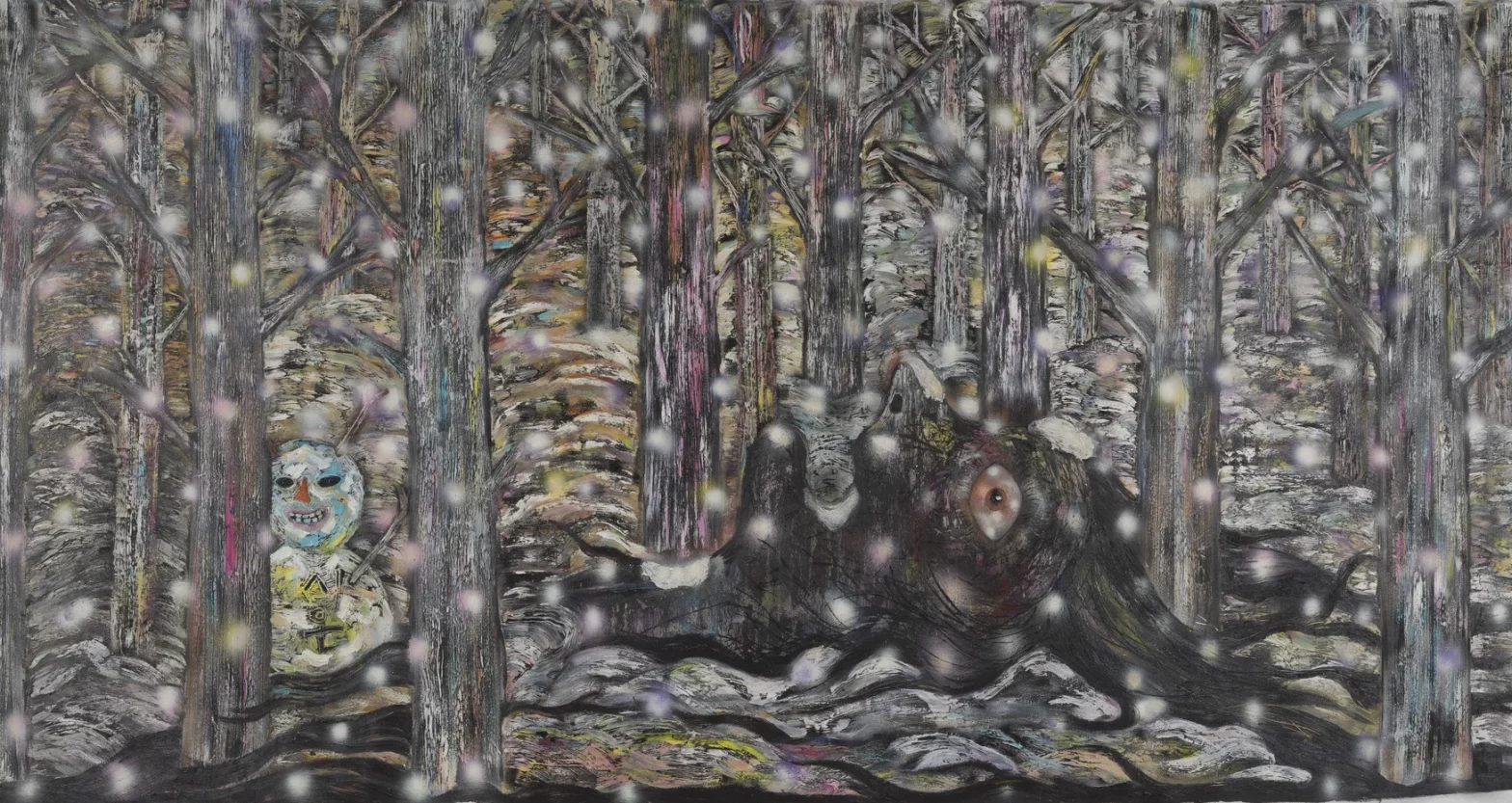
The formal and narrative richness of Si On’s work, the diversity of techniques she employs, the multidirectional cultural paths she follows, the visual and emotional intensity of her practice, and finally her predilection for working on a large, even monumental scale, all encourage us to think of the artist behind „It’s a Lonely Road” as a total artist. Her works evoke associations with various moments in the history of art: one might speak of Dadaism, Pop Art, Nouveau Réalisme, arte povera, or Postmodernism, as well as inspirations drawn from the shamanic traditions of her native Korea, comics from Japan, where she studied, or the folk art of Poland, where she has lived for the past decade. Yet none of these interpretative frameworks fully grasp the phenomenon of her practice. It is perhaps better sought in the direct resonance between a sensitive individual and the complexity, terror, chaos, and apocalyptic beauty of the contemporary world.
“My work did not come from artistic traditions,” says Si On. “It emerged from disorientation, limitation, curiosity, destruction, dirty streets, abandoned objects, and personal truths that, despite everything, have always followed me closely.”
If there is a recurring motif running through Si On’s multifaceted and diverse body of work, it is a reappearing figure, a character that takes on many faces and inhabits many roles, which can be understood as the artist’s porte-parole, her representative within the worlds she constructs.
“She is made from what remains of me, from the fragments I cast aside that stubbornly refuse to disappear,” says Si On of this figure. “She is a wanderer. She moves through the past and the future as though they were part of the same corridor. She carries memories I never experienced and wounds I thought had healed long ago. She has no stable identity. She dissolves and takes shape again and again. She appears as a student, a goddess, a warrior, a child, as different incarnations of truths I am unable to confront in the present. Her teeth are the words I never managed to say. Her scream is the voice that remained trapped in my throat for years.”
This recurring protagonist, moving from one work to another, also appears in „It’s a Lonely Road”. Here, however, she seems to dissolve into a multitude of other figures created by the artist. It is precisely the crowd, the collective body, that becomes the subject of the exhibition’s central work, the sculptural installation „Used People. A Pile”.
Si On repeatedly incorporates found objects and personal belongings into her paintings, sculptures, and assemblages. The figures that constitute „Used People” were shaped from used clothing, material previously employed in the monumental installation „Doomsday”, presented at the Venice Biennale in 2022. The sculptures recall scarecrows and straw effigies, but also totems or makeshift textile caryatids. Their anatomies are reduced to simplified forms, their faces appear grotesque, and the purpose they might serve remains unclear.
The crowd is a highly mutable form. It can transform into a rebellious mob, a community bound together by solidarity and revolt, a fanatical congregation, a collective victim, or a collective perpetrator. Perhaps this is a crowd stripped of direction, one for which no place or purpose remains: a crowd of unwanted, abandoned, exploited, used, and exhausted people, all moving together along the same lonely road. One possible reading of the work is introduced by Zoi Michailova, the composer invited by Si On to collaborate on finding a voice and sonic presence for „Used People”. Their collaboration resulted in the sound installation presented within the exhibition.
The motif of collectivity, of multiplied faces, bodies, and recurring rhythms, also appears throughout the other works gathered in „It’s a Lonely Road”. Si On is widely recognised for her vibrant and expansive use of colour, with works that often seem to burst with chromatic intensity. In this exhibition, however, her palette becomes more restrained and subdued. Apocalyptic themes have long been present in her practice, as its emotional force has always emerged from a tension between wonder and dread in relation to the world. Yet in „It’s a Lonely Road”, one senses that the balance between these two affects has begun to shift.
Perhaps it has become difficult today to create a joyful exhibition, especially one concerned with portraying contemporary collectivities. The directions in which both politics and technology are moving do not suggest a hopeful future for the entity we call society.
„It’s a Lonely Road” would make a fitting title for a melancholic blues song. It is often said that, in the end, the path of the artist is always solitary. Traditionally, this has been the road travelled by individualistic figures. Yet this exhibition is presented at a time when entire societies, too, seem to be moving along lonely roads, drifting toward destinations they themselves do not fully recognise, and perhaps toward nowhere at all.
Stach Szabłowski.
Si On, born in 1979 in Dangjin, Korea, is regarded as one of the most compelling contemporary Korean artists. She studied painting at Mokwon University in Daejeon and later earned both her MA and PhD from Kyoto City University of Arts. After spending several years in Japan and New York, she moved to Kraków, where she currently lives and works.
In her artistic practice, Si On explores themes of sensitivity, vulnerability, and the multidimensional nature of human spirituality, which she understands as a dynamic network of experiences, tensions, and various forms of influence. Engaging with the complexity of inner conflict, she constructs her works as rich and intricate tapestries. She draws from reality both discarded fragments and seemingly insignificant objects, as well as things that are precious and meaningful. Combining the low with the elevated, the valuable with the useless, she freely juxtaposes and transforms disparate elements into cohesive wholes. Inspired by shamanism, ritual, and spirituality, she approaches art as a therapeutic and transformative process.
Si On’s works exist between painting and sculpture, taking on expressive forms and evolving into multilayered compositions. Over time, her practice has shifted toward increasingly abstract and intuitive forms that incorporate a wide range of materials. The artist subjects her works to constant transformation, reconstructing, repainting, and reshaping them over and over again. This continuous and harmonious process of change encourages growth and renewal, making her practice a reflection of the fluid nature of creativity itself.
Si On has presented her work in numerous solo exhibitions, including „Beasts and Blossoms” at T293 Gallery in Rome (2024), „I Am an Outcast from the World” at James Fuentes Gallery in New York (2023), „A Peace Brimming with Malice at Edel Assanti” Gallery in London (2023), „Shaman Woman” at HOS Gallery in Warsaw (2020), and „MAM Project 028” at Mori Art Museum in Tokyo (2020). She has also participated in many group exhibitions, including „Uncombed, Unforeseen”, „Unconstrained” at the 2022 Venice Biennale and „Paint Means Blood: Woman, Affect, and Desire in Contemporary Painting” at the Museum of Modern Art in Warsaw in 2019. Her works are held in the collections of institutions including the Brooklyn Museum in New York, the High Museum of Art in Atlanta, the Mori Art Museum in Tokyo, and MOCAK Museum of Contemporary Art in Kraków.