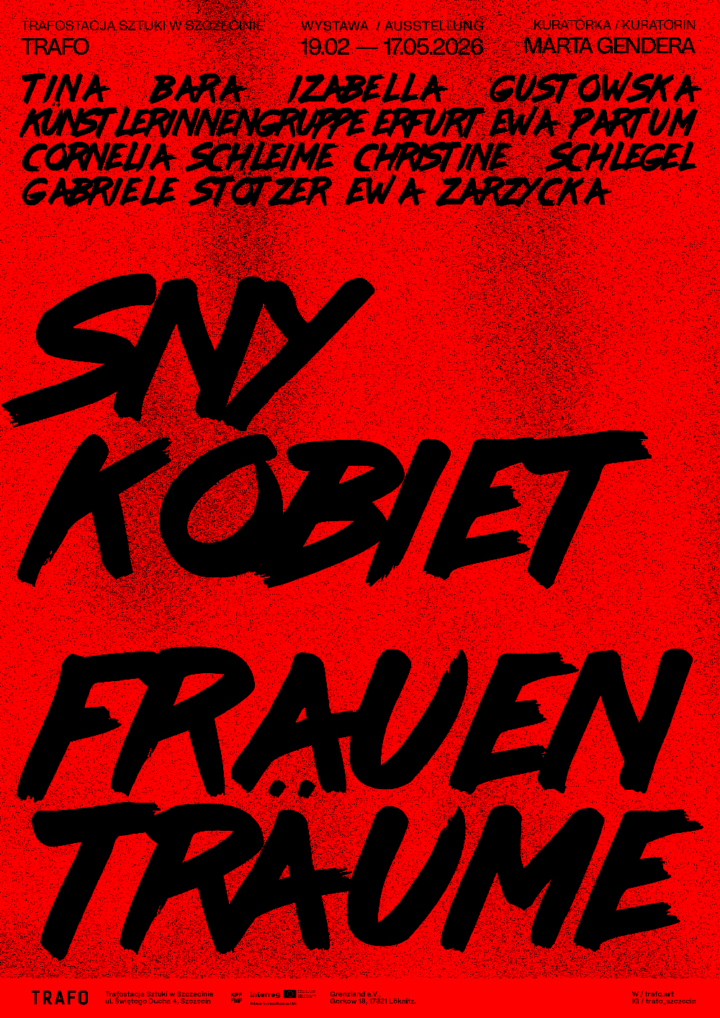
EXHIBITION: WOMEN’S DREAMS / FRAUENTRAUME
An imagined encounter between women artists active in the 1980s in the GDR and the People’s Republic of Poland – one that political circumstances at the time made impossible.
Artists: Tina Bara, Izabella Gustowska, Künstlerinnengruppe Erfurt, Ewa Partum, Cornelia Schleime, Christine Schlegel, Gabriele Stötzer, Ewa Zarzycka.
Curator: Marta Gendera.
Women’s Dreams stages an imagined encounter between female artists active in the 1980s in East Germany and Poland – one that the political circumstances of the time made impossible. The exhibition brings together works by Polish artists Ewa Zarzycka, Ewa Partum, and Izabella Gustowska alongside those of German practitioners Christine Schlegel, Cornelia Schleime, Gabriele Stötzer, Tina Bara, and the collective Künstlerinngruppe Erfurt. Their works share a critical stance toward the social and political norms imposed on women, coupled with a determination to assert control over their own image. The artists challenged the portrayal of women in socialist media, resisted prescribed gender roles, confronted discrimination, and expressed their desires with remarkable clarity and courage.
The 1980s were shaped by martial law and the closing of borders between ostensibly fraternal states. Heightened political repression, scarce resources for artistic production, and a pervasive sense of hopelessness on both sides of the border prompted many to pursue “internal emigration” or to leave abroad. A third path was alternative, underground activity – often a radical and uncompromising engagement with the authorities that demanded the invention of new languages and strategies. Artists turned to experimental media: staging performances, filming with 8 mm cameras, exploring graphic techniques, publishing zines, and creating collages. In front of conservative audiences, they exposed and repainted their bodies, while also constraining and binding them, laying bare the political repression they faced. Women’s art in the 1980s was diverse, dynamic, and defiant – closely linked to the punk scene in the GDR, and drawing on avant-garde traditions in Poland. The artists presented in the exhibition are further connected by a thread of solidarity and sisterhood, manifested through collaborative initiatives, independent gallery practices, alternative exhibition formats, and sustained mutual support throughout the creative process.
In Women’s Dreams, the act of looking acquires an added layer of meaning, foregrounding the tension between observing and being observed. This dynamic is embedded in the exhibition’s architecture, which offers two perspectives: a conventional mode of display and an elevated viewpoint that frames the exhibition as a contemporary dialogue with the past.
Further information here.