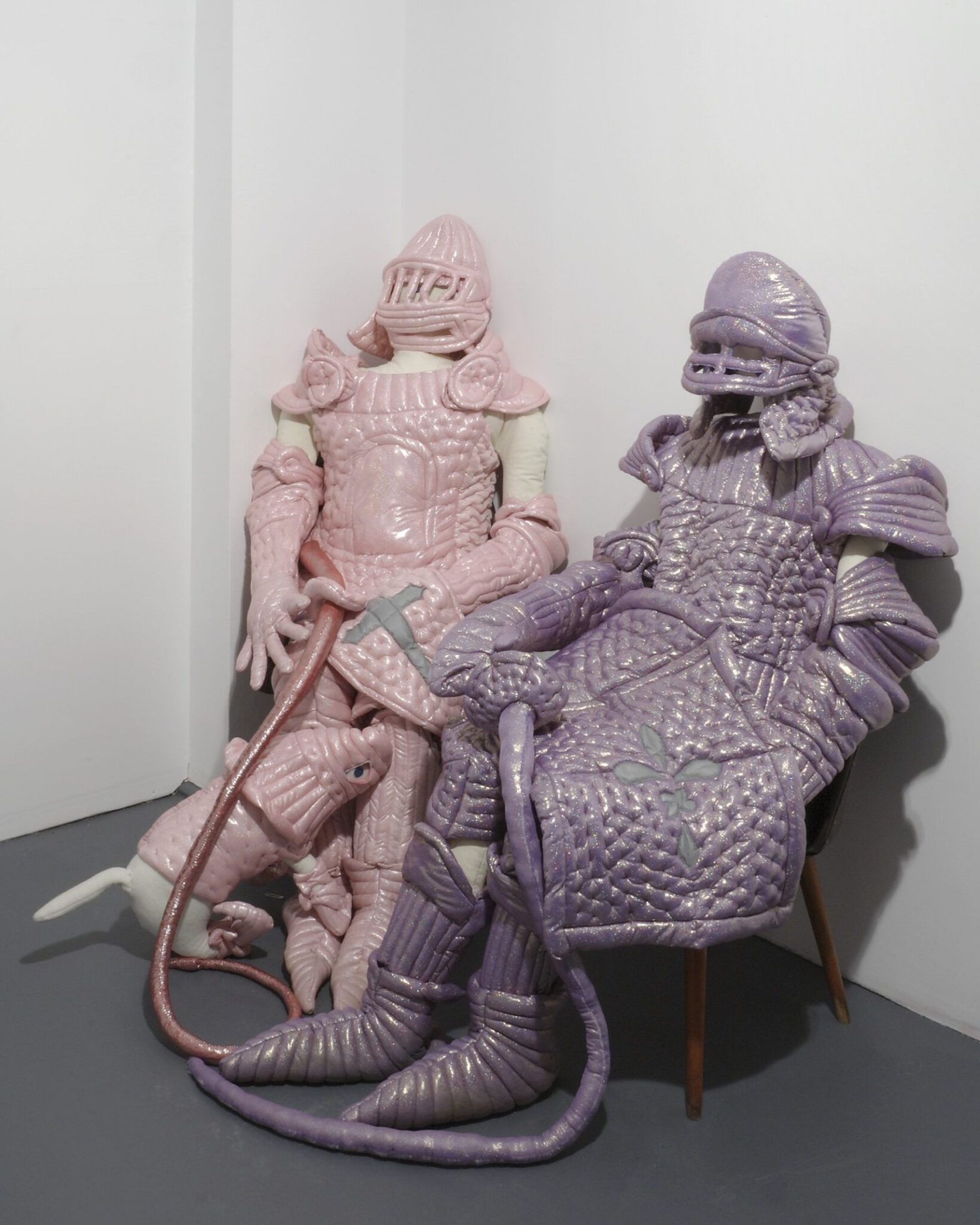
EXHIBITION: THE CENTRE OF GRAVITY | WOMEN’S CONGRESS 2026
OPENING: 04/09/2026, 18.00
Is a medium merely an artistic tool? For centuries, it has also been a vehicle for specific cultural and social norms, as well as one of the most enduring hierarchical divisions in the field of visual arts. This division did not disappear with the development of modernism, but rather took on more subtle forms, present in museum classifications, market values, critical language, and the very way of thinking about work, monumentality, and the medium. Since the 1960s, women artists have consciously begun to utilise media historically associated with femininity – textiles, ceramics, weaving, and creative practices associated with the domestic space – not as peripheral practices, but as critical tools revealing mechanisms of exclusion, marginalisation, and symbolic degradation.
In this context, the concept of “equality” signifies the possibility of transcending aesthetic and material gender roles. For decades, female artists have occupied historically masculinised territories, while male artists – though less frequently – have engaged with historically feminised media. A clear asymmetry emerges: female artists working in “masculine” media have historically gained prestige, while male artists utilising media deemed “feminine” often risked a loss of status. This narrative isn’t about a simple role reversal – it’s about revealing that the very division between “masculine” and “feminine” media has always been merely conventional.
A textile art piece can be monumental and intellectually sophisticated, a steel sculpture can reveal fragility and intimacy, an ornament can become a critical tool, and conceptual practices can be based on meticulousness, repetition, and manual labour. A large steel structure is a product of collective endeavour, a small ceramic piece proves to be a critical gesture, and a work on paper demands monumental scale. The centre of gravity shifts to a place previously overlooked.
Artists: Andreea Anghel, Michalina Bigaj, Konrad Gubała, Justyna Koeke, Eliška Konečná, Magdalena Lazar, Bartek Materka, Aleksandra Nenko, Małgorzata Malwina Niespodziewana, Wojciech Ireneusz Sobczyk.
Curator: Weronika Ptak
Visual identity: Agata Biskup